The Iron Bridge: Bridging the Gap Between Theory and Execution Through Automated Precision
It began with a tremor.
It began with a tremor.

It was 40,000 years ago when the last Neanderthal drew their final breath. They did not know it was the end. To them, the world was still whole—cold, yes, but familiar. They hunted mammoths with spears, buried their dead with care, painted red ochre on cave walls. They were intelligent, adaptable, emotionally rich. And yet, within a few centuries, they vanished—not because they were weak, but because the world had changed in ways they could not comprehend.

It began with a whisper.
It began with a whisper in a laboratory in Basel, 1928. Alexander Fleming noticed something strange: a mold had killed the bacteria surrounding it in his petri dish. He didn’t know it then, but he had stumbled upon penicillin—the first true antibiotic. The discovery was elegant in its simplicity: a natural compound, produced by Penicillium notatum, capable of dismantling bacterial cell walls without harming human tissue. It was, in the language of science, a perfect theory: specific, reproducible, and profoundly life-saving.

It started with a tweet.
A climate scientist posted a graph showing Arctic sea ice decline since 1980---sharp, alarming, statistically rigorous. The caption: “Linear regression of SIE (sea ice extent) over 43 years yields R² = 0.92, p < 0.001.”


It began with a question no one dared to ask aloud: Why does the universe feel so much bigger than any of us?
In 2018, a neuroscientist in Berlin sat across from a Zen monk in a quiet café. She wanted to know how meditation altered brain activity. He asked her: “Do you feel the silence between heartbeats?” She laughed politely, then published a paper on default mode network suppression. He wrote a haiku about the breath before thought.
Neither understood the other’s language. But both were staring at the same mirror---each seeing only a shard.
This is our condition: fractured. We have physicists who map the birth of stars with equations so precise they predict gravitational waves decades before detection. We have poets who describe the ache of loneliness in three lines that make strangers weep. We have philosophers who argue whether consciousness is an illusion---and yet, no one can explain why the color red feels like anything at all.
We have mastered the how, but forgotten the why. We’ve quantified everything except meaning.
And yet---somewhere beneath the noise of specialization, beneath the silos of academia, beneath the algorithms that feed us curated fragments---there’s a quiet hum. A longing.
Not for more data.
But for wholeness.
This is the story of how we’re beginning to put the mirror back together.
It was 2017, and the blockchain world was buzzing. A new startup called ChainSecure had just announced a revolutionary consensus protocol—“NebulaBFT”—that claimed to achieve “unbreakable security” by scaling to 10,000 nodes. Their pitch was simple: more nodes = more decentralization = more trust. Investors poured in. Journalists wrote breathless headlines: “The End of Centralized Control?” “A New Dawn for Trustless Systems?”
In 2013, Edward Snowden walked out of the NSA’s Hawaii surveillance station with a hard drive containing thousands of classified documents. He didn’t steal secrets to sell them---he wanted the public to know. And for a moment, it worked. The world watched as the machinery of mass surveillance was laid bare: PRISM, XKeyscore, the blanket collection of metadata. Headlines screamed. Governments scrambled. Lawyers filed suits. For 72 hours, the truth pulsed like a live wire.
Then came the counter-narrative.
Within weeks, the story morphed. Snowden became a traitor. A spy. A narcissist. The leaks were “unverified.” The documents, “incomplete.” The real threat? Not surveillance---but the chaos of exposure. By month’s end, the U.S. government had successfully reframed the narrative: You’re safer with us watching. The truth hadn’t been buried. It had been drowned.
This is not an anomaly. It’s a law.
Information---like heat, like energy---does not stay contained. It leaks. Always. Through cracks in firewalls, through slips of the tongue, through the involuntary twitch of an eyelid. But when it escapes, it doesn’t arrive intact. It arrives distorted. Buried under layers of spin, fear, self-interest, and the human brain’s insatiable hunger for a story that makes sense.
This is narrative entropy.
Not just the spread of information---but its degradation. The inevitable decay of truth under the weight of competing narratives. Like a sapling in the shade, truth doesn’t die from lack of water---it dies because the forest around it grows too dense, blocking the sun.
This is not a tale of failed security. It’s a tale of human nature.
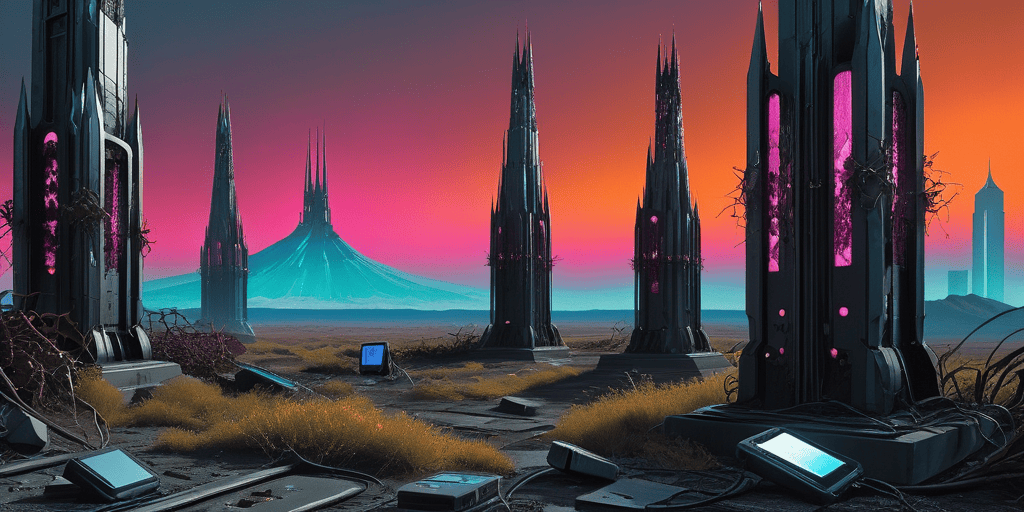
It started with a coffee maker.
Not the old one --- the clunky, chrome-plated beast from 1987 with a visible heating element and a removable filter basket you could clean with your fingers. No, it was the new one: sleek, touch-sensitive, whisper-quiet, with an app that let you schedule brews from your phone. You pressed one button. It brewed. Perfect cup, every time.
Then it broke.
Not dramatically --- no smoke, no sparks. Just… stopped. The screen blinked “Error 07.” You googled it. A forum post said, “Replace the water pump module.” You ordered a 120 repair service --- or a 30% discount on a new model.
You bought the new one.
This isn’t an isolated incident. It’s the norm. And it’s not just coffee makers. Your smartphone? Unrepairable without proprietary tools and firmware locks. Your car? A rolling supercomputer with 100 million lines of code --- and no owner’s manual that explains how the adaptive cruise control decides when to brake. Your thermostat? A black box that learns your habits but refuses to tell you how.
We live in an age of astonishing technical achievement --- yet we are becoming profoundly, dangerously ignorant about how the world works.
This is not a failure of education. It’s a design choice. A cultural surrender.
We have traded understanding for convenience. We’ve outsourced our curiosity to algorithms, our competence to corporations, and our agency to interfaces. And in doing so, we’ve performed a slow, silent lobotomy on the collective mind.
Welcome to the Age of Epistemological Fragility --- where we can operate machines, but cannot explain them. Where we rely on systems we don’t comprehend --- and are powerless when they fail.