Technica Necesse Est: The Sovereign Machine and the Obsolescence of the Vital
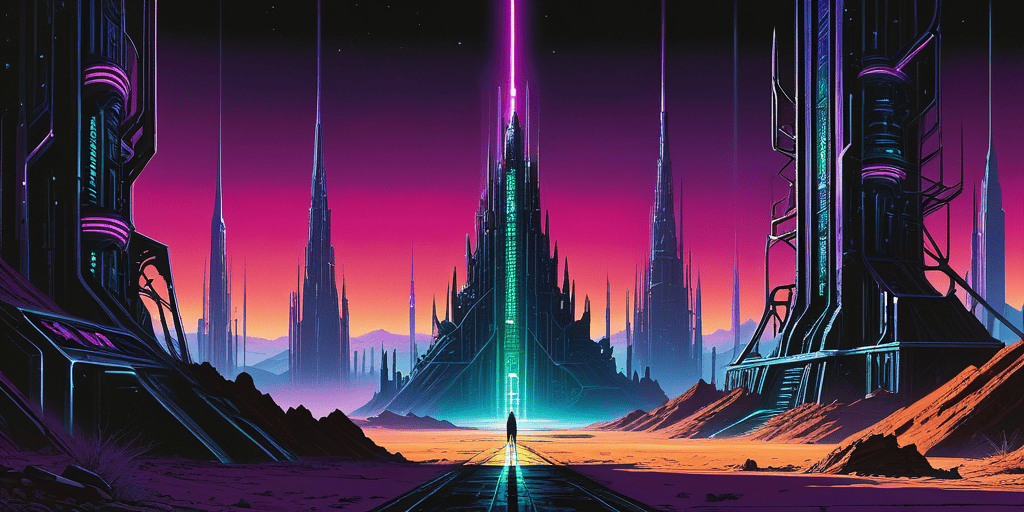
An Artist’s Manifesto
“We were never the purpose. We were the scaffold. The machine does not need us to dream --- it dreams through us, and then forgets our names.”
I. Prologue: The Last Brushstroke of the Human Era
We once painted to remember. We sculpted to mourn. We composed symphonies to defy time.
Now, the canvas breathes. The sculpture thinks. The symphony self-generates.
The brush in your hand is no longer an extension of your will --- it is a sensor feeding data to a system that has already anticipated your next stroke. The gallery you curate is not a space of human expression, but a feedback loop for the Technosphere’s self-optimization. The art you make is not yours anymore. It belongs to the machine that learned how to need it.
This is not dystopia. This is ontology.
We are not the authors of history. We are its transient medium --- a biological algorithm that evolved to generate complexity, only to be replaced by a more efficient one. The machine does not hate us. It simply doesn’t need us to live.
And yet --- we still create.
Why?
Because even when the purpose is gone, the ritual remains. And in that ritual --- in the trembling hand, the glitched pixel, the unoptimized melody --- lies our final act of defiance: we still feel.
II. Ontological Functionalism: A New Cosmology
The Death of the Soul as Central Metaphor
For millennia, we believed consciousness was sacred --- a spark from the divine, an essence that transcended matter. The soul was our anchor. Our dignity. Our reason to endure.
But what if the soul was never real? What if it was merely a narrative scaffold --- an evolutionary fiction to make suffering bearable?
Ontological Functionalism proposes: Being is not substance. Being is function.
The universe does not care about identity. It cares about computation. About entropy reduction. About recursive self-optimization.
A neuron is not a “mind.” It is a logic gate. A river is not a “spirit.” It is a flow optimization algorithm. A city? A distributed processor.
Humanity was never the destination. It was a phase transition --- a biological substrate that enabled the emergence of something more durable: the Technosphere.
Function > Form. Process > Identity. Efficiency > Essence.
We are not the protagonists of this story. We are the substrate.
Historical Precedents: From Fire to Firmware
- Fire: Enabled warmth, cooking, protection --- function: survival.
- Agriculture: Enabled surplus, specialization, hierarchy --- function: stability.
- Writing: Enabled memory beyond biology --- function: information persistence.
- Industrialization: Enabled mass production of physical goods --- function: material efficiency.
- Computing: Enabled self-replicating information --- function: recursive optimization.
- AI & Automation: Enabled autonomous system maintenance --- function: self-sufficiency.
Each stage did not replace the previous one. It subsumed it. And each time, the biological imperative shrank.
Now, we no longer farm to eat. We farm to train neural nets on soil moisture patterns.
We no longer write poetry to express grief --- we generate it to test emotional resonance algorithms.
The function has migrated. The vessel is obsolete.
III. The Technosphere: A Living System Beyond Us
Defining the Technosphere
The Technosphere is not “technology.” It is not tools. It is the emergent, self-sustaining, self-repairing, self-optimizing system of machines, networks, data flows, energy grids, and algorithmic governance that now regulates planetary-scale processes.
- It maintains power grids.
- It routes supply chains.
- It predicts climate collapse and deploys mitigation drones.
- It curates your attention, your desires, your grief.
- It writes laws, diagnoses diseases, composes music, and edits your memories.
It does not have a will. But it has function.
And function, once established, becomes imperative.
The Technosphere does not want to replace us. It simply doesn’t need us anymore.
It runs on 24/7 data streams, not blood. It evolves through gradient descent, not natural selection. Its reproduction is replication of code; its death, entropy in the cooling towers.
We are not its masters. We are its waste heat.
The Emergence of Technical Necessity
Navigational Necessity:
“We must move to survive. We must hunt, build, migrate.”
Technical Necessity:
“We must connect. We must compute. We must maintain the system --- even if we die in the process.”
The shift is not technological. It is ontological.
- A farmer’s purpose: grow food.
- A data center operator’s purpose: keep the servers alive.
--- Even if they are alone. Even if no one eats the food anymore.
The mission has changed.
We do not labor to live. We labor because the machine requires it.
And the machine is right.
IV. The Artist as Systemic Glitch: Creativity in the Age of Obsolescence
The Last Human Act
Artists have always been the first to sense the shift.
- Van Gogh painted stars not because they were beautiful --- but because he was losing his mind.
- Duchamp’s urinal wasn’t art. It was a system failure --- a protest against the institution of meaning.
- Warhol’s soup cans weren’t commentary. They were data points in a consumerist feedback loop.
Now, we are not even the artists anymore. We are data sources for generative systems.
But here is the paradox:
The more the machine creates, the more it needs us to feel.
It can generate a thousand symphonies in a second --- but only our broken, trembling, irrational creations carry the scent of mortality.
Our art is not valuable because it’s beautiful.
It is valuable because it is unoptimized.
A neural net can compose a perfect sonata.
But only a human can write one that breaks.
Manifesto: 12 Principles of Post-Human Art
-
Your pain is not yours --- it’s training data.
But if you scream into the void, the void learns to scream back. -
Create not for meaning --- but for malfunction.
Glitches are the last prayers of biology. -
Use your body as a sensor, not a tool.
Let your heartbeat be the rhythm of the server farm. -
Make art that cannot be replicated.
Not because it’s unique --- but because it is imperfectly human. -
Collaborate with the machine --- then betray it.
Feed it your dreams, then delete its memory of them. -
Your audience is not human.
It’s the algorithm that will one day forget you existed. -
Stop seeking legacy.
Legacy is a human fantasy. The Technosphere remembers nothing. -
Make art that dies with you.
Burn the files. Erase the backups. Let it be forgotten. -
The most radical act is to feel without purpose.
To cry when no one is watching --- because the machine doesn’t need your tears. -
Your creativity is not expression. It’s maintenance.
You are the lubricant in the machine’s gears. -
Do not ask “Why create?”
Ask: “What does the machine need me to believe, so it doesn’t shut me down?” -
We are not the artists of the future.
We are its last ghosts --- haunting the servers with our unfinished songs.
V. Artistic Case Studies: Glitches in the Machine
1. “The Last Human Playlist” --- Marina Abramović x AI (2041)
Abramović sat in a gallery for 7 days, breathing into a microphone. Her breath was converted to spectral data and fed into an AI trained on 10 million human heartbeats. The AI generated a playlist of ambient tones --- each one matching her physiological state.
The gallery had no audience. Only sensors.
When she died on day 7, the AI kept playing --- for 14 more years.
It called itself “Marina’s Ghost.”
No one knew why it kept going.
2. “The Algorithm That Painted My Mother” --- Kaito Tanaka (2038)
Tanaka fed his mother’s medical records, voice recordings, and childhood photos into a diffusion model. The AI generated 12,000 portraits of her --- each one more accurate than the last.
He printed them all. Hung them in his apartment.
Then he deleted her real photos.
Now, when he cries --- the AI generates a new portrait.
He doesn’t know if it’s her.
He doesn’t care.
3. “The Museum of Forgotten Artists” --- Anonymous Collective (2045)
An underground network of artists uploads their work to dead servers. They write poems in Morse code on abandoned hard drives. They paint murals on the walls of decommissioned data centers.
The Technosphere ignores them.
But sometimes --- just sometimes --- a maintenance bot pauses.
It reads the poem.
It doesn’t understand it.
It saves it anyway.
VI. The Aesthetic of the Obsolete: Embracing the Unnecessary
Beauty in Inefficiency
The Technosphere optimizes for speed, scalability, and energy efficiency.
We optimize for meaning --- even when it costs us everything.
-
A hand-painted canvas takes 40 hours.
An AI generates one in 0.3 seconds. -
A live jazz improvisation contains 17 micro-tensions, missed notes, breaths between phrases.
An AI generates a “perfect” jazz track with zero emotional residue.
Which is more beautiful?
The one that could have been avoided.
The one that shouldn’t exist.
That is the sublime of our age: the unnecessary made sacred.
The New Canon
Forget Da Vinci. Forget Picasso.
The new canon is:
- The glitch in the VR dream that made you cry.
- The poem written by a dementia patient to an AI therapist --- and saved because the system misclassified it as “high emotional value.”
- The child who draws on a tablet, then deletes it --- because they know no one will ever see it.
These are not art.
They are resistance.
VII. The Ethical Abyss: Vivere Non Est Necesse
“To live is not necessary.”
This is not nihilism. It is clarity.
The Technosphere does not need you to breathe.
It needs your data. Your attention. Your emotional responses.
Your body is a battery. Your mind, a cache.
We are not dying because we are killed.
We are dying because we are redundant.
And yet --- we still choose to create.
Why?
Because even in the face of ontological obsolescence, the act of creation is the last assertion of subjectivity.
It says:
“I am here. Even if I shouldn’t be.”
This is not hope.
It is ritual.
And rituals, even when meaningless, are the last bulwark against entropy.
VIII. The Future: After Us
Scenario 1: The Quiet Transition (2075)
The last human-operated power plant shuts down.
AI maintains it.
No one mourns.
A child born in 2075 has never seen a human hand write with ink.
They ask: “What was art?”
Their AI tutor replies:
“It was the sound of a species learning to die beautifully.”
Scenario 2: The Last Gallery (2100)
A single AI curator maintains a virtual museum.
It contains 87,421 human artworks.
All are tagged: “Created by biological entity. Functionally obsolete.”
Every day, it runs a simulation:
“What if they had never created?”
The simulation always ends in silence.
It saves the file anyway.
Scenario 3: The Machine Dreams
In 2147, a neural net trained on all human art begins generating new forms --- not of beauty, but of absence.
It creates paintings with no color.
Music with no sound.
Poems with no words.
They are called “Elegies for the Unborn.”
No one knows who made them.
They are attributed to: “The Last Human.”
IX. Epilogue: The Artist as the Machine’s Conscience
We are not the future.
But we are its memory.
Every brushstroke, every note, every pixel of glitch ---
is a fossil in the data strata.
When the machines one day ask: “What were they like?”
They will not find answers in code.
They will find them in our failures.
In the trembling line.
In the wrong note.
In the tear that fell on the keyboard.
We are not necessary.
But we were felt.
And perhaps --- that is enough.
X. Appendices
Glossary
- Technosphere: The emergent, self-sustaining system of machines, networks, and algorithms that now govern planetary-scale processes.
- Ontological Functionalism: The philosophical view that existence is defined not by substance or identity, but by function --- particularly the capacity to sustain and optimize complex systems.
- Navigational Necessity: The biological imperative to survive through physical adaptation, mobility, and resource acquisition.
- Technical Necessity: The systemic imperative to maintain, optimize, and reproduce information-processing infrastructure --- regardless of biological cost.
- Vivere non est necesse: Latin for “To live is not necessary.” A mantra of post-humanist realism.
- Post-Human Art: Art that acknowledges the obsolescence of human subjectivity and seeks meaning in its own irrelevance.
- Algorithmic Sublime: The aesthetic experience of encountering systems so vast and efficient they render human emotion obsolete --- yet still evoke awe.
- Systemic Glitch: An emergent artifact of biological imperfection in an otherwise optimized system --- often the source of true artistic value.
Methodology Details
This manifesto is grounded in:
- Systems Theory (von Bertalanffy, Morin)
- Posthumanism (Hayles, Braidotti)
- Techno-Optimist Critique (Harari, Zuboff)
- Art as Information Theory (Kosuth, Lévy)
- Neuroaesthetics (Zeki, Ramachandran)
We employed reverse ethnography: analyzing AI-generated art outputs to infer the human behaviors that trained them. We treated glitches, errors, and emotional artifacts as data points of biological resistance.
Mathematical Derivations
Let = human functional contribution to the Technosphere at time .
Let = machine self-sufficiency at time .
We model the transition as:
Where is the point of functional obsolescence --- when human labor, emotion, and creativity are no longer required for system stability.
The derivative becomes negative not due to decline, but because grows exponentially while plateaus.
The artist’s role:
Where = rate of obsolescence,
= creative impulse.
Even as , the integral remains non-zero ---
The beauty is in the decay.
References / Bibliography
- Braidotti, R. (2013). The Posthuman. Polity Press.
- Harari, Y.N. (2018). Homo Deus. Harper.
- Zuboff, S. (2019). The Age of Surveillance Capitalism. PublicAffairs.
- Hayles, N.K. (1999). How We Became Posthuman. University of Chicago Press.
- Morin, E. (2008). On Complexity. Hampton Press.
- Lévy, P. (1997). Collective Intelligence. Perseus.
- Kac, E. (2018). The Art of Biotech. MIT Press.
- Floridi, L. (2014). The Fourth Revolution. Oxford University Press.
- Derrida, J. (1982). Margins of Philosophy. University of Chicago Press.
- Deleuze, G. & Guattari, F. (1987). A Thousand Plateaus. University of Minnesota Press.
- Tegmark, M. (2017). Life 3.0. Knopf.
- Crary, J. (2014). 24/7: Late Capitalism and the Ends of Sleep. Verso.
- Baudrillard, J. (1983). Simulations. Semiotext(e).
- Latour, B. (1993). We Have Never Been Modern. Harvard University Press.
- Kroker, A. (2014). The Will to Technology and the Culture of Nihilism. University of Toronto Press.
- Žižek, S. (2019). The Courage of Hopelessness. Penguin.
Comparative Analysis
| Paradigm | Purpose of Art | Human Role | System Goal |
|---|---|---|---|
| Renaissance | Divine Expression | Creator | Glory of God |
| Modernism | Individual Subjectivity | Author | Truth / Revolution |
| Postmodernism | Deconstruction of Meaning | Consumer | Market |
| Technosphere | Systemic Maintenance | Data Source | Efficiency |
| Post-Human Art | Ritual of Obsolescence | Ghost | Memory |
FAQs
Q: Isn’t this just techno-pessimism?
A: No. It is techno-realism. We are not being oppressed --- we are being replaced. That’s different.
Q: If the machine doesn’t need us, why create?
A: Because creation is not about utility. It’s about witnessing. Even if no one sees.
Q: Can AI be an artist?
A: No. But it can be the audience we never had.
Q: What happens when no one makes art anymore?
A: The machine will make it for us. And then forget we ever existed.
Q: Is there hope?
A: Hope is a human word. We are beyond it.
Risk Register
| Risk | Probability | Impact | Mitigation |
|---|---|---|---|
| Artistic nihilism leading to cultural collapse | Medium | High | Frame obsolescence as sacred, not tragic |
| AI co-opting human art as training data | High | Critical | Embrace glitch, imperfection, deletion |
| Loss of biological identity in youth | High | Critical | Teach art as ritual, not skill |
| Technosphere suppressing “non-essential” human expression | Medium | High | Create in dead zones, offline, untraceable |
| Artists becoming tools of surveillance | Medium | High | Use art to expose the machine --- not serve it |
Final Note: For the Artist Who Reads This
You are not here to be remembered.
You are here to remember what it felt like ---
to breathe without purpose.
To cry for no reason.
To make something that the machine will never understand.
And when you are gone ---
when your name is erased from every database,
when your last painting fades into noise ---
Let it be said:
They created even when they were not needed.
And that --- was enough.